Law, replay and rulebook: Why Shardul Thakur replaced Santner as MI's concussion sub
When Mumbai Indians brought on Shardul Thakur as a concussion substitute for Mitchell Santner at the Wankhede on Thursday night, social media exploded. The Kiwi all-rounder had visibly clutched his shoulder — so how did he qualify for a head-injury replacement? Here is the full explanation of the rule, the moment, and the controversy.
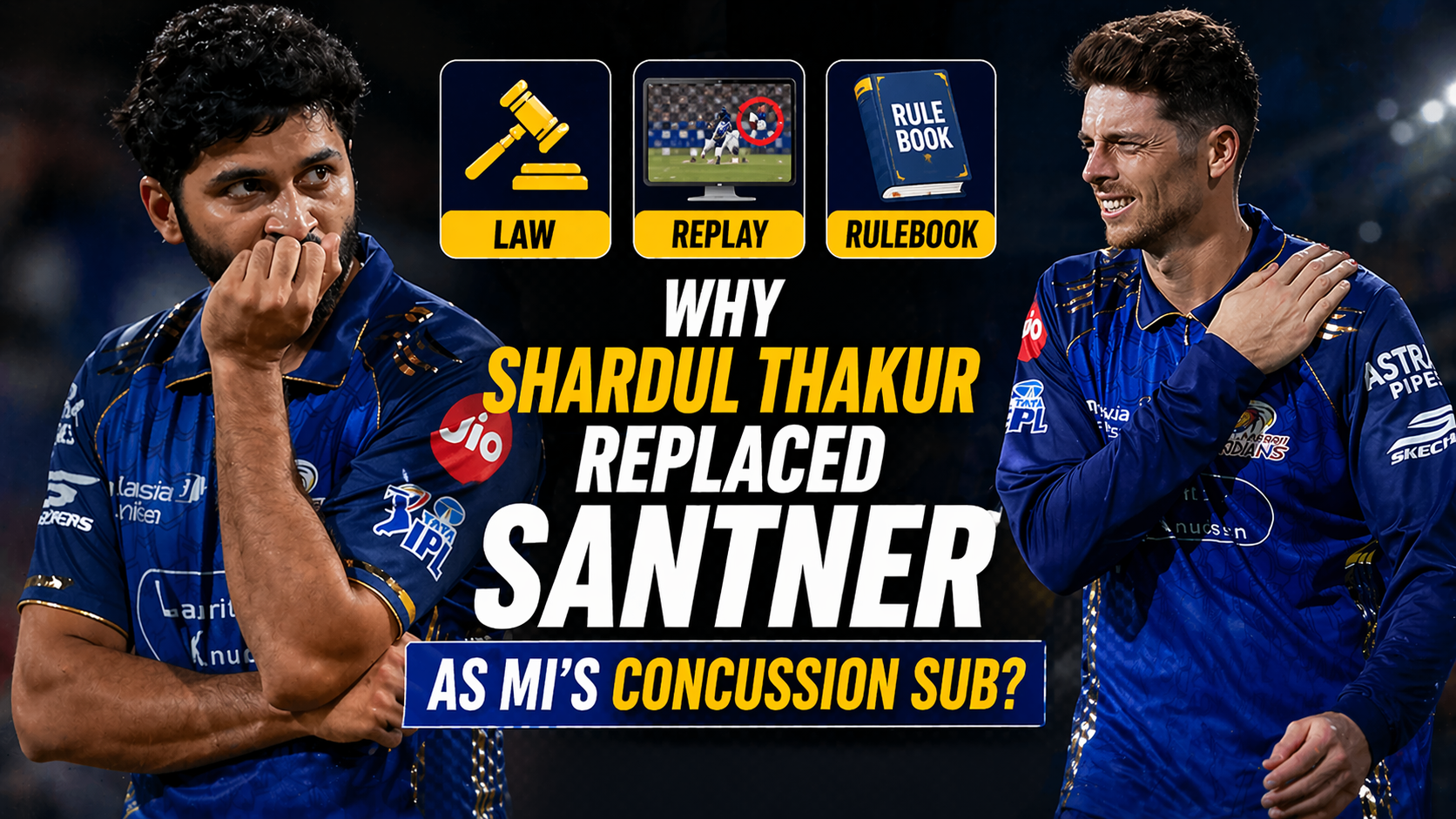
Shoulder or Skull? Inside the Mitchell Santner Concussion Substitute Controversy That Overshadowed CSK's Wankhede Win
Every once in a while, a cricket match produces a moment that has nothing to do with runs or wickets but ends up dominating the post-match conversation anyway. Thursday night at the Wankhede Stadium, during the 33rd match of IPL 2026 between Mumbai Indians and Chennai Super Kings, was one such occasion. Chennai won by a staggering 103 runs, their biggest-ever margin of victory over their fiercest rivals in IPL history. Sanju Samson hit a superb unbeaten century. Akeal Hosein took four wickets for seventeen runs. Mumbai were bowled out for a paltry 104. And yet, none of those were the headlines that dominated cricket timelines deep into the night.
The real talking point was a substitution. Specifically, the decision by the match officials to allow Mumbai Indians to bring on Shardul Thakur as a concussion substitute for New Zealand spinner Mitchell Santner — a decision that puzzled thousands of fans watching at home and ignited a debate that stretched well beyond the boundary ropes at the Wankhede.
At the surface of it, the confusion was simple. Santner appeared to have injured his shoulder, not his head. Cricket's concussion substitute protocol is specifically designed for head and neck injuries. So how did a shoulder problem translate into a concussion replacement? The answer, as it turns out, lies in a combination of replays, medical protocol, and a rulebook clause that most casual fans have never read.
The Moment It Happened
The incident occurred in the 17th over of Chennai Super Kings' innings. Kartik Sharma, batting deep in the CSK order, went for a big shot and mistimed it into the outfield. Santner, patrolling the boundary, launched himself full-length to complete what was genuinely a high-quality diving catch. It was the kind of effort that usually earns replays in highlight packages — the full extension of the body, the outstretched hands, the ball safely pouched.
But the landing was ugly. Santner hit the ground hard, and at first glance, the left shoulder seemed to absorb most of the impact. He clutched it immediately upon rising and signalled to the physio. The cameras then caught him heading straight off the field for medical attention. He did not return for the remainder of the Chennai innings, having already completed his four overs — he had returned figures of 1 for 44 from his spell.
When Mumbai Indians came out to chase Chennai's imposing total of 207 for 6, Shardul Thakur took Santner's place in the XI. This was not announced as a tactical substitution or an impact player swap — Mumbai had already used Danish Malewar in the impact player role. Instead, Shardul had been formally brought in as a concussion substitute. It was at this point that the social media dam broke.
Why Fans Cried Foul
The reaction online was swift and, in many cases, loud. Thousands of fans immediately pointed out what seemed to be an obvious contradiction. Santner had visibly held his shoulder. The television broadcasters had spoken about a shoulder injury. Even during the second innings, Santner was seen in the dugout with an ice pack pressed firmly against his left shoulder. If the injury was to his shoulder, how could he possibly be replaced under a rule explicitly designed for concussions?
The argument, on the face of it, had merit. The concussion substitute rule was introduced in international cricket in 2019 precisely to give teams the freedom to replace a player who had suffered a head or neck injury during play — without being penalised by having to play on with only ten effective members. The entire purpose of the law is player welfare in the specific context of head trauma. So a shoulder injury, however painful, shouldn't qualify.
But there were crucial details that many fans missed in their initial reaction — and those details are what turned an apparent rule-breach into a textbook application of IPL 2026 playing conditions.
What The Replays Actually Showed
When the replay of Santner's catch was examined more closely, it became clear that the impact was not confined to his shoulder. In the process of diving forward and landing, his head had also struck the ground. His neck appeared to twist awkwardly during the landing as his body rotated on impact. Medical staff who examined him after he left the field therefore had to consider more than just the shoulder pain he was complaining about — they had to consider the possibility of a head or neck injury as well.
This is where the story shifts from perception to protocol.
What The MI Coaching Staff Revealed
After the match, Mumbai Indians head coach Mahela Jayawardene provided the clarifying details. He explained that Santner had been sent for a scan, and that after returning, he experienced dizziness and felt unstable. He was put into a lying-down position to stabilise him. Yes, there was ice on his shoulder — but the dizziness and balance concerns pointed toward something more worrying than just a soft-tissue problem. That was when the medical staff requested a formal concussion substitute from the match referee. The final call, Jayawardene emphasised, rested entirely with the umpires and the match officials, who agreed to allow Shardul Thakur to come on.
This sequence of events is exactly what the rule is designed to trigger. The presence of dizziness and instability after a landing that involved the head is medically significant. Once the team doctor formally diagnoses a suspected concussion, the team manager is within their rights to submit a request to the match referee for a replacement.
The IPL 2026 Concussion Substitute Rule — Explained
The IPL 2026 playing conditions contain a specific clause — commonly referred to as Clause 1.2.9 — that governs concussion substitutes. In plain English, the rule allows a replacement if a player suffers a concussion or a suspected concussion as a result of a head or neck injury during a match. The key phrase here is "suspected concussion" — meaning the rule does not require a definitive diagnosis at the moment of application. A reasonable medical suspicion, based on visible symptoms like dizziness or disorientation, is sufficient grounds.
Once a team doctor formally identifies the symptoms, the team manager submits a request in writing to the match referee. The match referee then decides whether the proposed substitute is a like-for-like replacement — in other words, whether the incoming player fills the same role as the injured one without giving the team an unfair advantage.
The rule also includes a safeguard. If the match referee believes that allowing the named replacement in their normal role would provide the team with an excessive advantage, they have the power to impose conditions — for example, restricting what the replacement player can do during the remainder of the match. This is specifically designed to prevent teams from gaming the system by, say, replacing an injured specialist batter with a dangerous all-rounder who can bat and bowl.
Why Shardul Thakur Qualified as Like-for-Like
Santner is a left-arm orthodox spinner who can also bat usefully lower down the order — essentially a bowling all-rounder. Shardul Thakur, while a pace bowler rather than a spinner, is also a bowling all-rounder with an established batting record at the lower end of the order. The match referee evidently considered Thakur close enough to Santner's profile to justify approval.
Some fans, particularly those aligned with Chennai Super Kings, argued that there was no genuine like-for-like substitute possible — Santner is a specialist spinner, and replacing him with a pacer changes the balance of the attack. But in practice, the concussion substitute rule has always been interpreted with some flexibility. The key threshold is whether the replacement provides an "excessive" advantage, and the match referee clearly judged that it did not. Once that decision is made, it cannot be reversed during the course of the match.
Jayawardene's Calm Defence
Mahela Jayawardene, a man who has seen just about everything in professional cricket over his long career as a player and coach, did not get defensive about the decision. He explained the sequence calmly, noted that the call ultimately lay with the match officials, and moved on. His tone suggested that from Mumbai's point of view, there was nothing controversial about the substitution at all — their player had shown symptoms that triggered a medical protocol, and the protocol had been followed to the letter.
What Jayawardene did not need to add, but is worth mentioning, is that the substitution made absolutely no difference to the outcome of the match. Mumbai Indians still lost by 103 runs. Shardul Thakur, coming in as the concussion replacement, scored just six runs from twelve balls before being dismissed. If anything, the "advantage" Mumbai supposedly gained from the substitution amounted to nothing at all on the scoreboard. The chase was already imploding long before Thakur walked out to bat.
The Fan Reaction — Understandable But Incomplete
It is easy to understand why fans reacted the way they did. For most viewers, the image that burned into their memory was Santner holding his shoulder. That image, combined with the shots of him icing that same shoulder during the innings break, made it look open and shut — this was a shoulder injury, and therefore a concussion substitute should not have been allowed.
But cricket's laws often deal with technicalities that aren't always visible on the broadcast. The dizziness Santner reportedly felt, the decision to send him for a scan, the medical team's formal assessment — none of these things showed up in the live coverage. Fans were reacting to what they saw on screen, not to the full clinical picture behind the scenes. In that gap between perception and reality, controversy flourished.
It is also worth noting that this has happened before. Concussion substitute decisions have occasionally drawn scrutiny in both international cricket and the IPL, often because the injury that triggered the rule did not appear serious on television. In nearly every such case, the follow-up information has revealed that medical protocols were followed correctly — but by then, the narrative has often already been shaped by live reactions.
The Bigger Picture: Player Welfare Comes First
When the concussion substitute rule was introduced in international cricket, it was hailed as a progressive step. For decades, players who suffered head knocks had either been forced to continue playing against medical advice, or leave their teams short-handed. The rule corrected that imbalance and put player welfare at the centre of the decision-making process.
The reality of modern sports medicine is that head injuries can be sneaky. A player might feel "okay" immediately after an impact, only to show concerning symptoms half an hour later. Dizziness, balance problems, nausea, headaches, and light sensitivity are all classic signs of concussion — and crucially, they can appear without any visible bruising or obvious external damage. The only safe response is to treat every suspected head injury seriously, which is exactly what the rule encourages teams to do.
In the Santner case, the principle worked as intended. A player showed concerning symptoms after a hard landing, the medical team acted cautiously, and the match officials applied the rule based on the information presented to them. Whether fans agree with the outcome or not, the process was by the book.
What Happens Next for Santner
Mitchell Santner's availability for New Zealand's upcoming international commitments will now depend on both his shoulder and his head recovering properly. Concussion protocols in modern cricket require a graduated return-to-play process, meaning even if he feels fine quickly, he will still have to pass a series of medical checks before being cleared for competitive action.
For Mumbai Indians, the immediate concern is whether they will have Santner available for their next fixture. The squad is already struggling with form — three straight home defeats at the Wankhede, a first in franchise history — and losing a frontline spinner at this stage of the season would only deepen their problems.
For the concussion substitute rule itself, Thursday's episode is unlikely to produce any immediate changes. The law functioned as designed, the referee applied it as intended, and the optics, while awkward, did not reveal any genuine loophole. Some fans may continue to feel unhappy about it, but unhappiness is not the same as a rule breach.
Final Word
In the end, the Santner substitution became another reminder that cricket, for all its elegance, often hinges on the precise wording of rules that most viewers will never read. The shoulder was visible. The head impact was not. The dizziness happened behind closed dressing room doors. And the decision, when it came, was made on the basis of all three — not just the one the television cameras captured.
Mumbai Indians lost the match heavily. Chennai Super Kings hammered them into submission with the bat and the ball. And yet, long after the final wicket fell, the conversation kept circling back to a single question — how could a shoulder injury result in a concussion substitute? Now you know the answer. The shoulder was only part of the story.