Why Mumbai Indians Are Struggling in IPL 2026: A Closer Look at Their Inconsistent Campaign
Mumbai Indians have endured a challenging IPL 2026 season so far, with inconsistency, batting concerns, and bowling struggles affecting their position on the points table.
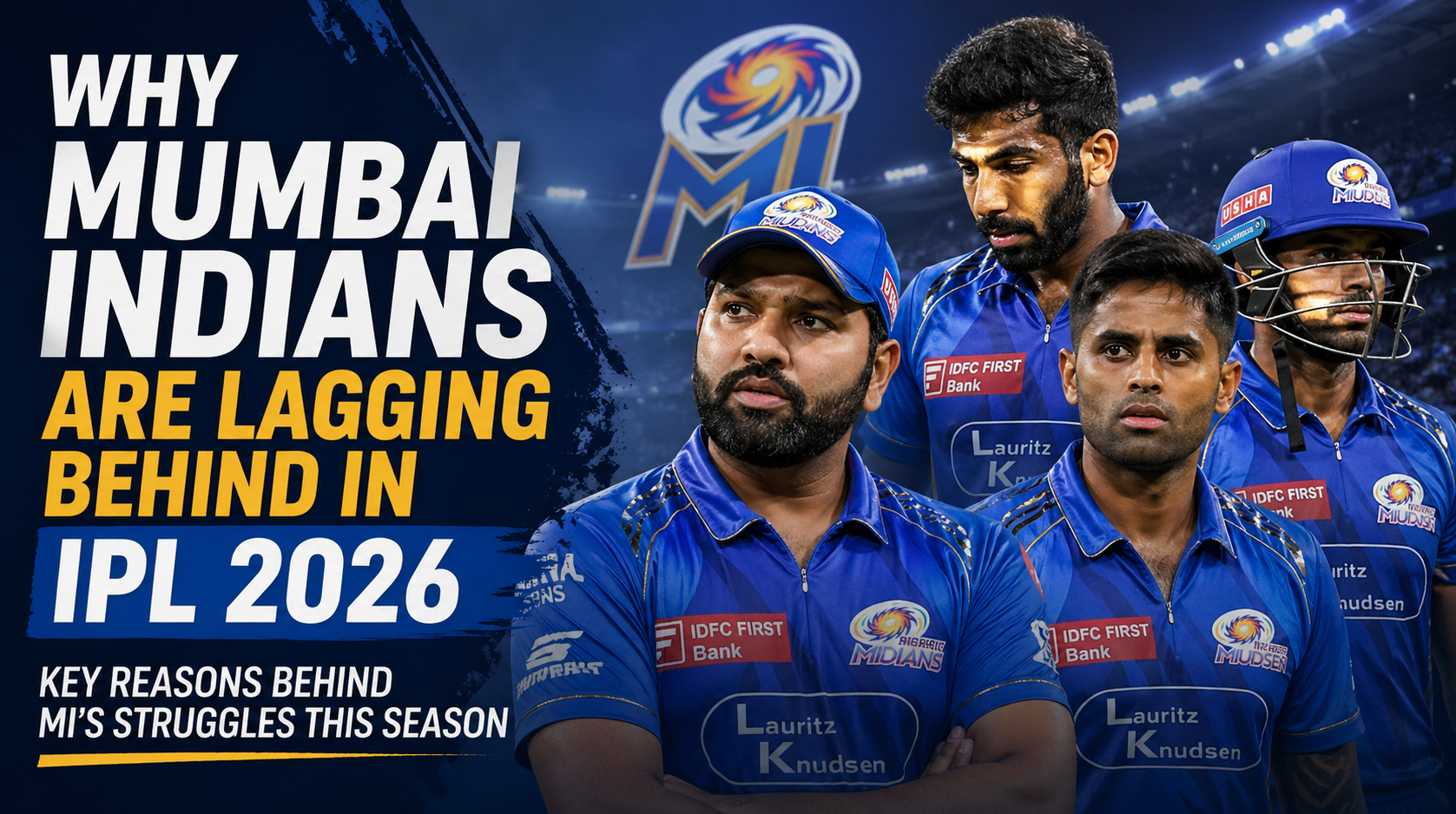
Mumbai Indians, one of the most successful franchises in the history of the Indian Premier League, have experienced a challenging phase in the 2026 season so far. While the team still possesses a strong lineup and experienced core, their results in the early and middle stages of the tournament have not fully aligned with expectations.
Rather than pointing to a single issue, the situation appears to be the result of multiple contributing factors — ranging from inconsistency in performances to execution under pressure. As the tournament progresses, understanding these aspects provides a clearer perspective on where the team currently stands.
Inconsistency in Results
One of the noticeable patterns in Mumbai Indians’ campaign has been inconsistency. The team has shown the ability to perform strongly in certain matches, only to follow those efforts with less convincing performances.
In a tournament like the IPL, where momentum often plays a significant role, maintaining consistency can be crucial. Teams that manage to build a sequence of positive results tend to carry confidence forward, while fluctuating performances can make it harder to establish rhythm.
For Mumbai Indians, this inconsistency has meant that they have not yet been able to secure a stable position in the points table.
Top-Order Performance and Early Overs
Another area that has drawn attention is the performance of the top order. The opening phase of an innings — particularly the powerplay — is often critical in setting the tone in T20 cricket.
At times this season, Mumbai Indians have found it challenging to fully capitalize on these early overs. This has not always been due to a lack of intent, but often the result of disciplined bowling from opponents and the need to balance aggression with caution.
When early wickets fall or scoring slows down in the powerplay, it can create additional pressure on the rest of the batting lineup.
Middle-Order Responsibility
With the top order not always providing strong platforms, the middle order has frequently had to manage demanding situations. This includes rebuilding innings after early wickets or accelerating scoring rates when required.
While there have been individual contributions, the overall consistency in this phase has varied. In T20 cricket, clearly defined roles — such as anchor, aggressor, and finisher — can help maintain structure within an innings. At times, Mumbai Indians have appeared to still be working toward that balance.
Bowling Execution in Key Phases
On the bowling side, Mumbai Indians have shown moments of control, but maintaining that control across all phases has been a challenge.
In particular, the final overs of an innings — often referred to as the “death overs” — have been a critical area. This phase requires precise execution of yorkers, slower balls, and field placements. Even small variations in execution can significantly impact the outcome.
There have been instances where opposing teams have been able to add crucial runs in these overs, influencing match results.
Impact on Net Run Rate
In a closely contested tournament, Net Run Rate (NRR) can play an important role in determining standings. Matches with larger margins — whether wins or losses — can influence this metric.
For Mumbai Indians, certain results have had an effect on their NRR, which adds another layer of importance to upcoming matches. Improving this aspect often requires not just winning, but doing so convincingly.
Team Combination and Adjustments
Another factor worth considering is team composition. Across a long tournament, teams often experiment with combinations to find the most effective balance.
Mumbai Indians have made adjustments to their playing XI, which can be part of a broader strategy to identify the best possible lineup. However, continuity can also be valuable, as it allows players to settle into defined roles and build on-field understanding.
Striking the right balance between flexibility and stability is an ongoing process for most teams.
Competitive Nature of IPL 2026
It is also important to consider the overall competitiveness of the current season. IPL 2026 has seen closely contested matches, improved bowling strategies, and evolving batting approaches.
In such an environment, even small margins — a missed opportunity, a few overs of pressure, or a late surge — can influence results. This makes consistency and execution even more critical.
Looking Ahead
Despite the challenges, the season is still open. Mumbai Indians have a track record of adapting and responding during difficult phases. The remaining matches provide an opportunity to build momentum and improve standings.
Key areas such as early partnerships, clarity in batting roles, and bowling execution in crucial overs are likely to be important as the team moves forward.
Conclusion
Mumbai Indians’ IPL 2026 campaign so far reflects the fine margins that define T20 cricket. Rather than a single issue, it is a combination of factors — consistency, execution, and adaptability — that has shaped their current position.
With experienced players and a proven track record, the team remains capable of responding strongly. As the tournament progresses, their ability to address these areas will determine how their season unfolds.
For now, their journey serves as a reminder that in the IPL, sustained performance across all phases is essential — regardless of past success.