Data Shorts: The anatomy of England's bowling masterclass in Bristol
England's clinical bowling choked India to 158 for 7 before Harry Brook (79*) and Phil Salt (59*) sealed a nine-wicket rout in Bristol to clinch the series 3-0. A deep dive into the numbers reveals how disciplined lengths, slower-ball bouncers and relentless pace inflicted a fifth straight T20I defeat on India — their first-ever such losing streak — as England surged towards the No. 1 ranking.
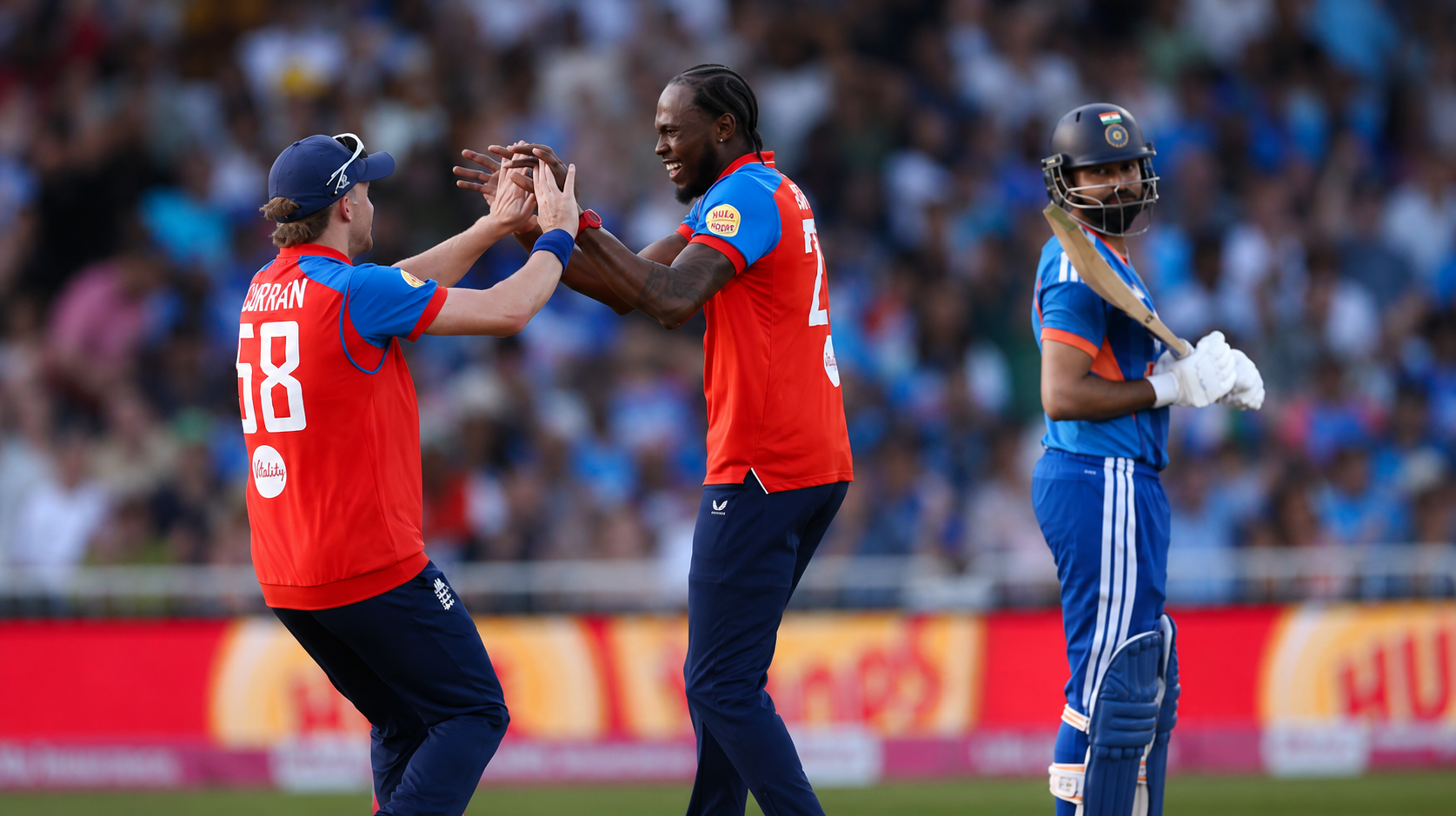
England completed another emphatic demolition of India in Bristol, sealing an unassailable 3-0 lead in the five-match series with a crushing nine-wicket victory. While Harry Brook and Phil Salt starred with the bat, the foundation was laid by a disciplined, collective bowling effort that suffocated India's innings. A closer look at the data reveals the anatomy of that masterclass.
Restricted to 158 for seven and then blown away in the field, India slumped to a record-breaking low, with the numbers laying bare just how comprehensively they were outplayed.
Death by discipline
At the heart of England's plan was relentless accuracy. Skipper Harry Brook explained afterwards that he simply asked his bowlers to repeat their lengths as often as possible, having identified that deliveries around the top of middle and leg stump were extremely hard to score off on a two-paced surface.
That discipline paid rich dividends. Whenever India tried to force the pace or manufacture room, they perished, unable to break free from the shackles England's bowlers had placed on them throughout the innings.
The two-paced pitch
The surface was central to the story. On a two-paced Bristol pitch, England's seamers cleverly took the sting out of the ball, and India repeatedly fell victim to variations. Both Tilak Varma and Washington Sundar were dismissed by slower-ball bouncers, unable to time their strokes as the ball gripped and held up.
The spinners exploited similar conditions. Neither Abhishek Sharma nor Shivam Dube could get going, both falling to mis-hits off spin — Dube holing out to yet another excellent catch by Tom Banton, who fielded superbly throughout the series.
The bowling figures that told the tale
The individual returns underlined England's control. Jofra Archer and Josh Tongue, the tormentors-in-chief all series, shared four wickets between them, continuing to exploit pace and steep bounce. Archer finished with 2 for 20, while Tongue took 2 for 36.
Perhaps most telling was the impact of the change bowlers. Sam Curran was hugely effective on a surface that suited him, conceding just 24 runs from his four overs, while off-spinner Will Jacks was nearly as miserly, returning 1 for 28 as he bowled his full allocation on home soil in a T20I for the first time.
Iyer's lone hand
Amid the collapse, captain Shreyas Iyer produced a defiant, counter-attacking innings, top-scoring with 79 from 49 balls including four fours and five sixes. He was particularly severe on Adil Rashid, taking the veteran leg-spinner for an uncharacteristic 49 runs from his four overs with a series of ferocious sweeps.
But Iyer's was a lone hand. For the third game running, teenager Vaibhav Sooryavanshi struck two early blows before falling short of 15, and with no other batter passing 30, India's 158 for seven always looked around 20 runs light on the surface.
A record-breaking chase
If England's bowling was clinical, their batting was ruthless. Brook, named Player of the Match, blasted an unbeaten 79 from just 35 balls, clearing the ropes four times, while Salt struck his second successive fifty with an unbeaten 59 from 42.
Their unbroken second-wicket stand of 146 came off just 70 deliveries, and England knocked off the 159-run target in only 13.5 overs — with 37 balls to spare. According to the data, this was England's fastest-ever T20I chase of a target of 150 or more, a statement of their sheer dominance.
An unwanted milestone for India
The defeat plunged India into the record books for the wrong reasons. It marked the first time in their history that they had lost five successive men's T20Is, a startling slump for the reigning world champions.
It also confirmed India's first back-to-back bilateral T20I series defeats since 2018-19, piling significant pressure on new captain Iyer barely two weeks into his tenure. He acknowledged the difficulty, framing it as a transition phase in which a young side, many playing in these conditions for the first time, would need to learn from their mistakes quickly.
England's ominous ascent
For England, the numbers point to a team hitting its peak. Since Brook took over the captaincy last year, they have now won 19 of their 22 completed T20Is, quietly establishing themselves as a world-class outfit in the format.
The victory sealed their first-ever bilateral men's T20I series win over India. Should they complete a clean sweep in the final match in Southampton, they will displace the world champions to become the No. 1-ranked T20I side, capping a remarkable turnaround from their earlier World Cup semi-final defeat to the same opponents.
The final word
The data from Bristol paints a clear picture: England won not through a single act of brilliance but through a meticulously executed collective plan. Disciplined lengths, clever use of the two-paced surface and relentless pressure dismantled India's batting, before Brook and Salt applied the finishing touches. For India, the statistics are a sobering read; for England, they are the mark of a side in imperious form.