Tilak Varma Enjoys the Pressure of Finishing as India’s Vice-Captain Adapts to a New Role
Tilak Varma may prefer batting at No. 3, but India’s vice-captain is embracing the greater responsibility of the middle order. He is prepared to anchor a recovery after early wickets or attack immediately when the team needs a quick finish. Ahead of the fourth T20I against West Indies in Hyderabad, Tilak also reflected on his unusual run-out in Indore.
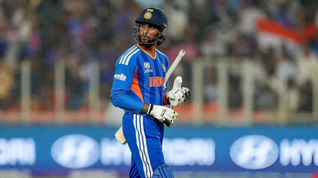
India vice-captain Tilak Varma is learning to enjoy one of the most demanding roles in T20 cricket: adapting to the match situation and delivering whatever the team needs from the middle order. Although he remains fond of batting at No. 3, the left-hander is embracing the responsibility of playing lower down the order as India prepare for the fourth T20I against West Indies in Hyderabad.
Tilak's role has evolved since the 2026 T20 World Cup, when India's batting order was reshuffled following a defeat to South Africa. He moved to No. 6 for the must-win match against Zimbabwe and responded with an unbeaten 44 off 16 balls. Since then, he has largely continued to bat lower down the order, learning to switch between building an innings and attacking from the first delivery.
Why Tilak Still Loves Batting at No. 3
Tilak has built an impressive record in the top order. He has scored 651 T20I runs at No. 3 at a strike rate of approximately 151, with both his international T20 centuries coming from that position. His unbeaten scores of 107 against South Africa at Centurion and 120 at Johannesburg in November 2024 established him as a dangerous option in the Powerplay.
Batting at No. 3 gives a player the opportunity to settle in early, take advantage of fielding restrictions and play with attacking freedom. Tilak recognises those benefits, but he also understands that India's crowded top order means flexibility is essential.
Rather than push for his preferred position, he wants to preserve the team's existing combinations and make the most of the opportunities he receives in the middle order.
Two Different Responsibilities in the Middle Order
Tilak explained that his responsibilities can change dramatically depending on when he comes to the crease. If India lose early wickets, he may need to steady the innings, manage the risk and ensure the team bats deep into the final overs.
However, if the top order has already built a strong platform and batted into the 14th or 15th over, he may be required to attack immediately. That means changing gears without taking time to settle, a skill that demands both technical preparation and mental strength.
Tilak has been practising for both situations. He believes that the ability to recognise what the team needs and adapt quickly is essential for a successful middle-order batter in modern T20 cricket.
Pressure Is What Makes the Role Special
The Indian vice-captain says he enjoys situations in which the team needs him to take responsibility. His approach is based on confidence, preparation and the willingness to accept different challenges rather than focus on a preferred batting position.
Tilak also stressed the importance of understanding conditions, identifying bowlers he can attack and choosing shots that suit the pitch. For him, success is not defined by where he bats, but by whether he can help India win from that position.
This mindset has become particularly important as India develop their middle-order combinations. With several players competing for places in the top four, Tilak's willingness to take on the harder job gives the team another option when matches become difficult.
A Special Homecoming in Hyderabad
The fourth T20I carries additional significance for Tilak because Hyderabad is his home ground. Playing in front of the local crowd while serving as India's vice-captain makes the occasion particularly meaningful for the left-hander.
India entered the match leading the five-game series 2-1 after recovering from their defeat in Ranchi with a 14-run victory in Indore. A win in Hyderabad would secure the series for the hosts, making the contest important for both the team's campaign and Tilak's homecoming.
West Indies remain a dangerous opponent, particularly because of their power-hitting depth. India will need to maintain their bowling discipline while making the most of their batting opportunities.
Tilak Explains His Run-Out in Indore
Tilak also addressed the unusual run-out he suffered during the third T20I. He and Axar Patel briefly stopped running because they believed the ball had reached the boundary after a fielder appeared to make contact with the advertising hoarding while attempting to stop it.
The two batters had reached the same conclusion, but the ball had been returned towards Axar's end while Tilak was facing away from the play. Their hesitation allowed the fielding side to complete the run-out.
Tilak explained that he had misread the situation and joked that, in future, he would keep running even if the umpire signalled a boundary. His reaction showed that he was willing to acknowledge the mistake and move on rather than allow the incident to become a distraction.
India's Middle-Order Flexibility Could Prove Crucial
Tilak's evolving role reflects a wider requirement in T20 cricket: players must be able to perform different jobs within the same batting line-up. A batter who can rebuild after early wickets and accelerate immediately when required offers a captain greater tactical flexibility.
His experience at No. 3 gives him the foundation to construct an innings, while his recent work lower down the order is helping him develop the instincts required of a finisher. The challenge is to make those two approaches work without losing the confidence and attacking intent that have defined his game.
Conclusion
Tilak Varma continues to prefer batting at No. 3, but he is increasingly comfortable with the responsibility of India's middle-order role. Whether he must rescue an innings or attack from the first ball, the vice-captain wants to adapt to the situation rather than demand a fixed position. As India prepare for the Hyderabad T20I against West Indies, his flexibility could prove valuable in their push to seal the series.